
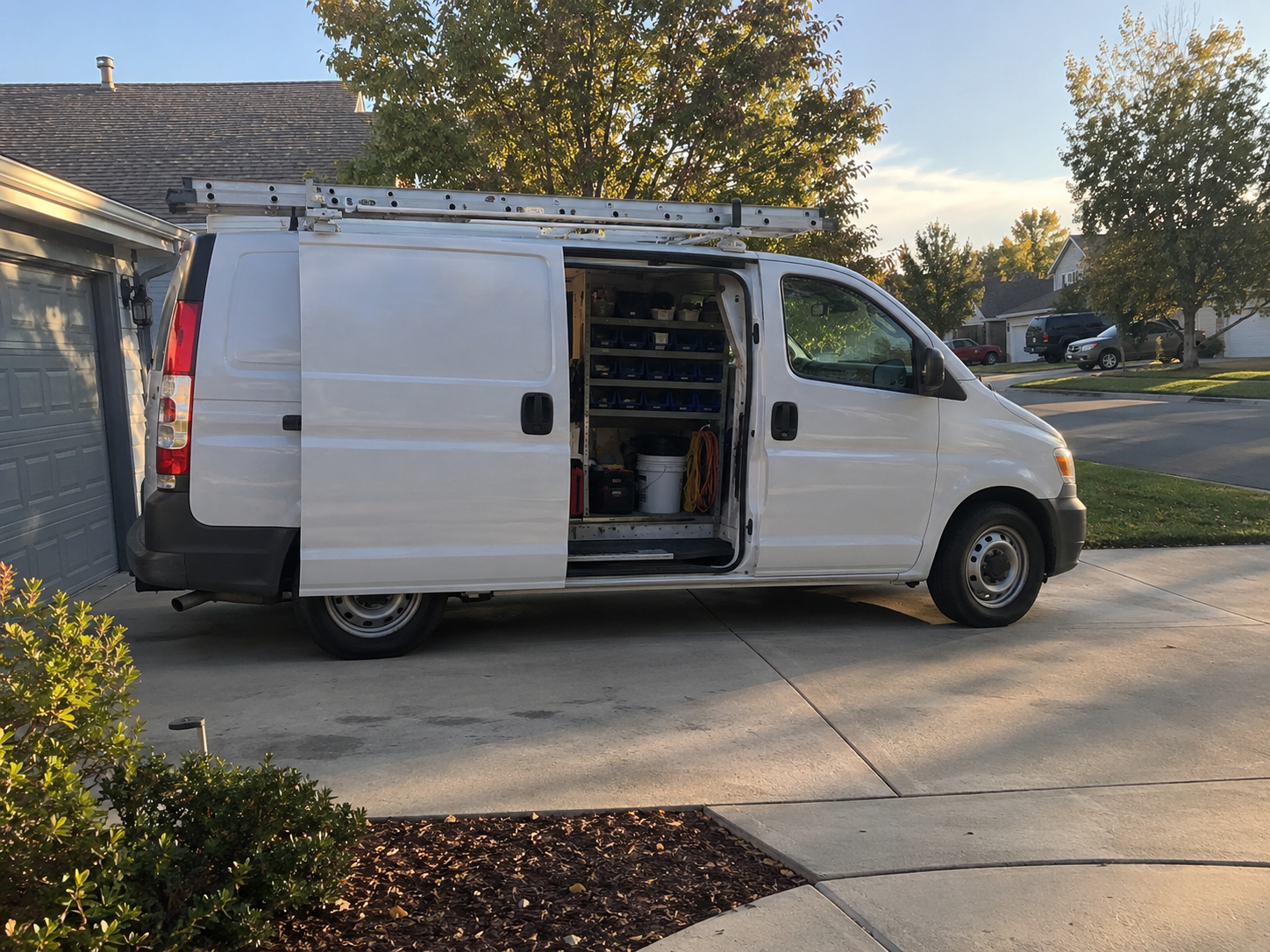
A plumbing operation had about $63,000 available to pay bills and a weekly minimum outflow of roughly $7,000. That is nine weeks of runway, and the owner did not know it.
The money was not hidden. It was scattered — some undeposited, some sitting in accounts nobody was reconciling against a forward view. What was missing was not cash. It was the sentence that turns cash into a decision.
Key Takeaways
- You have several crews running and no reliable read on which ones are profitable
- Your average ticket is a number someone quoted you once and nobody has retested
- You own trucks or equipment you suspect are underused but cannot prove it
- You know roughly what is in the bank and not at all what will be there in six weeks
What Should Trades Contractors Look for in a Fractional CFO?
Look for someone who starts with labor and equipment, not with the P&L. In a multi-crew trades business, almost all of the margin variance lives in how hours and trucks get deployed, and almost none of it is visible in a monthly income statement.
The specialty trade contractors segment is the largest part of the construction sector by employment, and that is exactly why the financial mechanics differ. When your cost of goods sold is mostly people, the accuracy of your margin is the accuracy of your labor coding — nothing more sophisticated than that, and nothing less consequential.
How Do You Know If Your Job Costing Is Accurate Enough?
Test it against something you already believe. Pick a job you are certain went well and one you are certain went badly, and check whether the numbers agree with you. If they don't, the reporting is not describing the business.
The most common failure in trades is not missing cost — it is cost landing in the wrong place. Warranty work and rework get performed by the same crews on the same trucks, and unless something forces those hours back onto the original job, every callback quietly improves the margin on the job that caused it.
The second most common failure is a stale benchmark. One home-service operation was running against an average ticket figure that turned out to be materially below what they were actually collecting. The number had been true once. Nobody had retested it, and pricing decisions were being made against it.
Stale benchmarks are worth a specific warning because they are contagious. A figure that entered the business as a rough estimate gets repeated in meetings, then quoted to a lender, then used to size a hiring plan. By the time anyone questions it, several downstream decisions are resting on it, and correcting it means revisiting all of them. The defense is unglamorous: retest the handful of numbers the business actually runs on, on a schedule, whether or not anyone suspects them.
A third failure is subtler and specific to multi-crew operations. When two crews work the same job in the same week, hours frequently get coded to whichever crew the office associates with that customer rather than to the crew that actually performed the work. Company margin stays correct. Crew-level margin becomes fiction, and crew-level margin is what you would use to decide who to promote, who needs training, and which crew can handle a bigger job.
What Does Labor Cost Analysis Actually Look Like in Practice?
It looks like connecting three things that usually live apart: scheduled hours, coded hours, and billed hours. The gaps between them are where trades margin goes.
There is a sequencing point here as well. Labor analysis is worth doing before any pricing change, not after, because a price increase applied to a job type whose true cost is unknown simply moves the error to a bigger number.
Utilization is the other half. The same plumbing operation was carrying trucks that were underused to the tune of several thousand dollars a month — a fixed cost being spread across fewer revenue-producing hours than the fleet was sized for. That is not a purchasing mistake. It is a scheduling question that nobody had framed financially.
A fractional CFO's contribution here is not a new report. It is the question that makes the existing data answerable: what would this cost per billable hour if the schedule held, and what is it actually?
How Should a Trades Business Forecast Cash?
Weekly, and forward. Monthly cash reporting is nearly useless in a business where receipts arrive daily and payroll is fixed and frequent.
The plumbing operation above had roughly $13,000 to $13,500 sitting undeposited and about $50,000 across accounts. Neither figure was wrong. What did not exist was the arithmetic that turns them into runway — the weekly minimum outflow, the expected receipts, and the resulting date at which the two cross.
That arithmetic takes an afternoon to build and changes how an owner thinks about hiring, equipment, and whether to chase a large job with slow terms.
What Is the Difference Between a Fractional CFO and a Fractional Controller for Trades?
A controller makes the numbers right. A CFO makes them consequential. In a trades business the controller work is genuinely heavy — reconciliation, job coding discipline, close cadence — and a lot of firms stop there and call it CFO service.
The distinction matters when a decision is on the table. Whether to add a crew, whether to raise prices, whether a truck earns its keep: those are questions about future economics, and they require someone whose job is the forecast rather than the ledger.
Our page on fractional CFO services for trades businesses covers how the two functions get scoped together.
When Should a Trades Business Bring in a Fractional CFO?
The usual trigger is not a bad year. It is a good one that felt uncomfortable — revenue up, crews added, and a persistent sense that the business got harder to see rather than easier to run.
Growth is what breaks informal financial management, because it breaks the owner's ability to hold the whole picture. A single crew is legible from the truck. Four crews across a service area are not, and the failure mode is that the owner keeps making the same intuitive calls with a fraction of the information those calls used to be based on.
The other common trigger is a financing conversation. Applying for a line of credit or an equipment facility surfaces every weakness in the reporting at once, usually on a deadline. Building the discipline before you need it is considerably cheaper than assembling it under a lender's timeline, and the resulting terms tend to be better.
How Do You Evaluate a Provider Without Getting Sold?
Ask them to look at one real job before they quote you. Not a sample, not a case study — one of your jobs, with its actual cost detail, and ask what they notice.
A provider who works in your industry will ask about warranty hours, retainage terms, and how burden gets into your pricing within the first few minutes. A generalist will ask about your accounting software. Both questions are reasonable. Only one of them is about your business.
Ask what happens in month one, and listen for whether the answer is a diagnostic or a deliverable. A firm that opens with a reporting package is selling you an artifact. A firm that opens by testing whether your existing numbers survive contact with a job you already understand is selling you the thing you actually need, which is a corrected view of your own business before anyone builds anything on top of it.
Finally, ask who does the work. Fractional engagements are sometimes sold by an experienced principal and staffed by someone considerably more junior. That is not automatically wrong — a lot of the monthly execution genuinely is controller-level work — but you should know it going in, because the value of the arrangement depends on how much of the senior person's judgment you actually get.
Your Next Step
Nine Weeks of Runway Is Only Useful If You Know You Have It
If you cannot say today what your cash position will be six weeks out, the gap is not a reporting gap — it is a forecasting one, and it is the fastest thing to fix.
Common Questions
Frequently Asked Questions
What Do Fractional CFO Services Cost for a Trades Contractor?
Cost tracks scope rather than company size, so the meaningful comparison is what is included. Weekly cash forecasting and labor cost analysis represent a substantially different engagement than monthly financial reporting, and providers quoting a flat number without asking about your crew count are pricing a product, not a service.
How Do I Improve Job Costing Accuracy in a Multi-Crew Business?
Start with warranty and rework hours, because that is where most trades businesses leak. If callback labor does not route back to the job that caused it, every problem job looks better than it was and your pricing inherits the error.
Should a Trades Business Hire a Fractional CFO or a Bookkeeper First?
A bookkeeper first, almost always. A CFO working on top of unreliable job coding will produce confident analysis of bad inputs, which is worse than no analysis. Get cost landing correctly, then bring in someone to interpret it.
How Often Should Trades Contractors Review Labor Cost Data?
Weekly for utilization, monthly for margin by job type. Labor is the fastest-moving cost in the business and the one most responsive to intervention, so a monthly-only review means acting on information that is already several payroll cycles stale.
Can a Fractional CFO Help With Pricing and Forecasting?
Those are the two areas where the role earns its keep. Pricing requires knowing true loaded cost per hour, and forecasting requires knowing what the schedule implies about cash. Both are analytical rather than clerical, which is what separates the function from bookkeeping.